Smart Grid and Energy Efficiency technologies constitute cutting-edge scientific fields in both countries and worldwide. In Greece they have been included among the priorities for funding by the European Commission during the 2014-2020 Multiannual Financial Framework. In Turkey there is an increasing number of innovative approaches and pilot projects, led by both the government and the universities. Ministry of Energy and Natural Sources, opened General Directorate of Renewable Energy in the last quarter of 2011. Together with The Scientific and Technological Research Council of Turkey (TUBITAK) they have several ongoing projects about biomass, wind turbine design, fuel cells, etc. In both countries significant research actions are in progress.
The department of Electrical Engineering of TEIWM has installed a microgrid consisting of a 2 kW PV plant with its inverters, a battery bank of 600 Ah capacity, a 1 kW wind generator and various loads (Fig. 1).
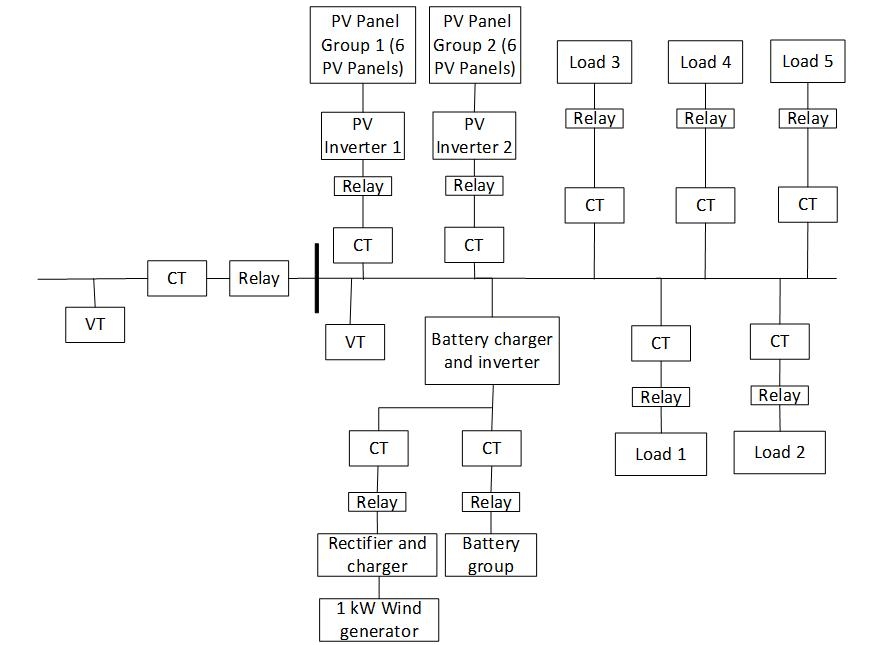
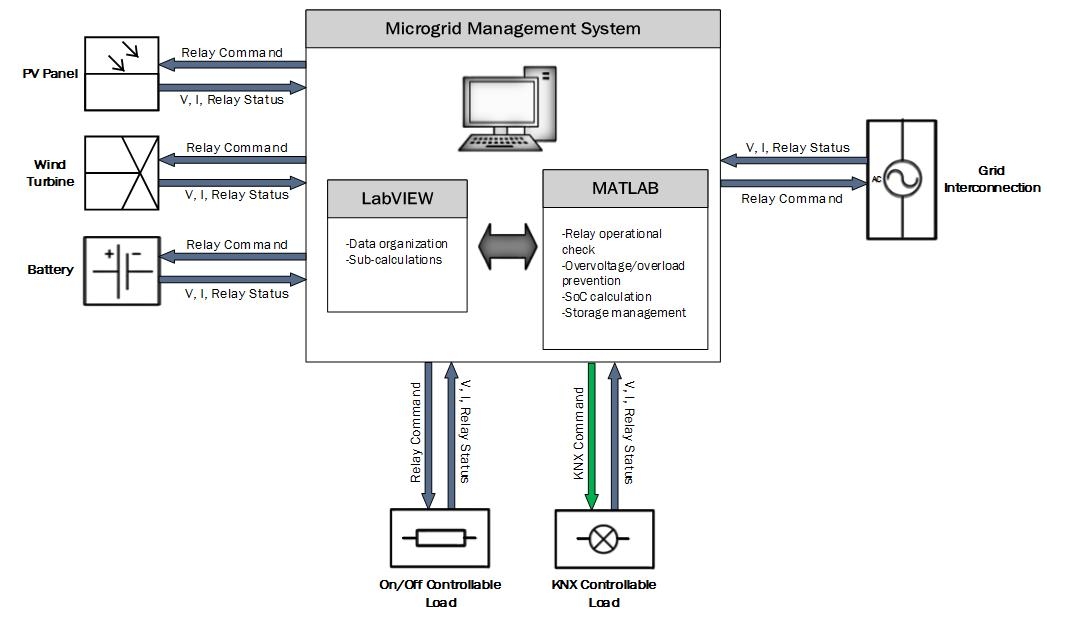
This microgrid is a representative example of the future smart distribution grid. A new control technique for this microgrid has been developed whereas an expansion of this microgrid is soon expected (Fig. 2). The TEIWM is also Scientific Partner of the worldwide organization for home and building control standard KNX and is now the leader partner of a project on Energy Efficiency in Buildings.
The department of Electrical Engineering of Istanbul Technical University (ITU) is an expert in Power Systems Analysis, Simulation, Reliability and control, having great experience in implementing Intelligent Method Applications in Power Transmission Systems. Recently established Distribution Automation Laboratory has advanced protection equipment and test sets for intelligent power system applications. The Turkish research team has ongoing research activities on load modelling and intelligent load management methods for residential loads. In addition to the experience gained on refrigerator modelling, considerable progress is achieved on thermostatically controlled load management in response to the events happening on the grid.
The increasing penetration of renewable energy sources into the grid may result in degradation in costumer power supply reliability as well as power quality. The solution to this problem is the development of one grid topology and the respective control infrastructure that are applicable to home microgrids up to the entire distribution grid. However, the control infrastructure of the smart distribution grid should be compatible and interact with existing home and building control technologies that are used mainly for energy efficiency. It should also interact with the utility in order to exploit the benefits and provide ancillary services of a smart grid. Thus extensive simulation and field tests need to be conducted.
At the facilities of the Technological Educational Institute of West Macedonia (TEIWM), Greece, the required modules for the control of a microgrid have been already developed and applied in experimental scale. This microgrid is a representative small smart distribution grid.
At Istanbul Technical University-Department of Electrical Engineering, by the use of protection equipments and motor-generator groups in the Distribution Automation Laboratory, load modelling, power system simulation and energy management system design to control the residential loads in response to grid’s request are being studied on. By the establishment of the new measurement and testing devices, the existing system will have the chance of being a test bed for innovative power system projects regarding smart distribution systems and building energy efficiency technologies.
The objectives of the project are the following:
a) Integration of Home Automation Technologies to Microgrid Energy Management: One of the most important parts of future smart grids topologies seems to be the microgrid, which is defined as a distribution grid including distributed PV plants, energy storage units and controllable loads. In the proposed project, the implemented smart distribution grid topology is a microgrid-based one and has only one difference from the existing distribution grid: A special control unit (SCU) is attached to each device or group of devices before connecting to the rest grid. All SCUs will consist of a simple metering module, a communication module, an activation module and a “smart” module. The “smart” module is integrated into software running on a microgrid-dedicated PC.
This software module should interact with microgrids containing SCUs, with microgrids that implement other open home and building control standards (e.g. KNX). The required modifications of the TEIWM microgrid will be defined in order to be compatible and interact with home and building control technologies used for energy efficiency (Fig. 3.).
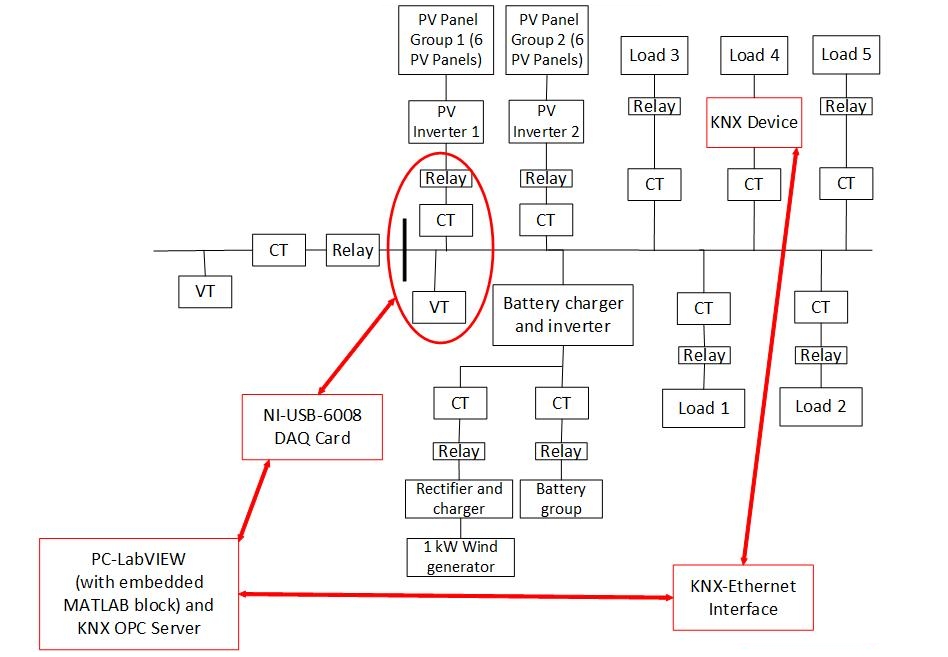
For this purpose, field tests will be conducted at the installed microgrid in TEIWM, after it is equipped with KNX devices, by members from both Greek and Turkish teams. The results of the filed tests will be used to develop an accurate simulation model for the final form of the microgrid.
b) Development of a Virtual Test Bed: In order to verify that the results from the field tests are applicable to the different utilities developed simulation models will be used to represent a virtual test bed. A distribution grid model based on field data will also be developed. The SEEMBEET virtual test bed will allow researchers to,
c) Analysis of Microgrid-Utility Interactions: The ancillary services that could be provided by the supply-side or the demand-side of a microgrid are expected to give great added value to the future smart grid. Such ancillary services are active and reactive power compensation, voltage and frequency regulation, spinning reserve, back-up supply, peak shaving and optimum economic operation in the context of day-ahead markets.
However, the successful implementation of these ancillary services by the smart grid depends firstly on the way active power P and reactive power Q is coupled with grid voltage V and grid frequency f. The way of coupling depends on the R/X ratio of the grid. This ratio depends on the microgrid dimensions and also shows great variation between the utility. Many scenarios will be studied in order to check the interaction between the utility and the microgrid.
The results of this study will be used to modify the microgrid control topology of TEIWM for making it completely integrated with the distribution and the transmission system. The researchers will concentrate on the problems originated due to the insufficient control strategies, measurement inefficiencies and inadequacies between the modules and will try to solve those problems for improved system reliability.
The developed simulation model, and established test systems are expected to be used in future’s pilot smart grid applications. They can be used in the planning, application and renovation phases of smart grid research activities of distribution network utilities. Various studies can be made on power system topologies including the distributed generators, local storage systems and controllable loads. Extended laboratory facilities and the developed model can also be used as an analysis tool for the adaptation of Turkish and Greek distribution and transmission systems with microgrids.
The developed simulation models will also be used for further case studies in the areas of:
The benefit for the environment is also obvious since the ways for increased penetration of Renewable Energy and Energy Efficiency technologies in the existing grid will be investigated.
One great benefit that could be one of the project outcomes is to check the anticipating reduction in installed centralized power capacity by the utilities. For example, for the installed microgrid the renewable sources and energy storage penetration will reduce the power supplied by the remaining grid. Since the load demand is always measured, the difference between peak load demand and peak remaining grid demand can provide the anticipating reduction in the supplied power by the utilities. The whole power system will be kept more stable and reliable using effective control strategies. This will in turn increase the system efficiency, customer satisfaction and utility benefits.
The benefits of the participants will be the further specialization and experimental investigation on renewable technologies integration and smart grid technologies. Experience will be gained on metering, communication, activation and software equipment that will be used for the future smart grid.